


Sandy Cheeks, Second Chances,- and the Truth About “Rescue”
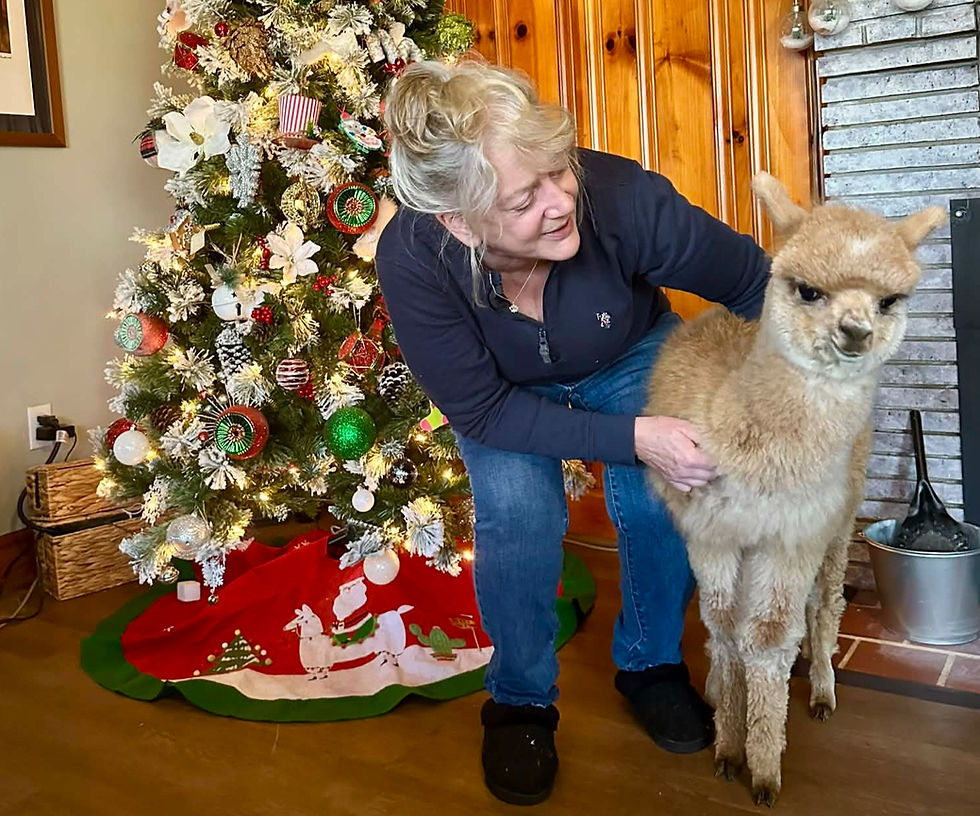
When my daughter and son-in-law saw a farm listing an alpaca named Sandy Cheeks, they didn’t hesitate. They knew I would be thrilled. I’ve always had a soft spot for bottle-raising alpacas - the fragile ones, the ones who need round-the-clock care, the ones who quietly rewrite your schedule and your sleep.
They also knew something else.
Bottle-raising camelids is not for the inexperienced.
It’s not simply “feeding a baby.” It’s a delicate balance of nutrition, immunity, gut health, and constant observation. Even under expert care, outcomes can be uncertain. Without that experience, survival rates drop dramatically. This isn’t criticism — it’s reality.
Sandy Cheeks arrived weighing just 23 pounds.
For context, that’s profoundly underweight for an 18 week old cria. She was bright-eyed and spunky - but under her fluffy fiber she was so small and thin, her body telling the story of good intentions paired with advice that simply didn’t serve her well. The farm that rehomed her did their best. I want to be clear about that. Most people who end up with a failure to thrive baby animal are not careless - they're doing the best. They are often hopeful, overwhelmed, and following guidance they believed was sound.
But biology doesn’t bend for hope. Crias can’t survive in the long haul on love and good intentions.
They survive on colostrum timing, proper milk formulation, watching for complications, correct feeding volumes and timing - the unglamorous, technical, exhausting parts of neonatal care. The parts that don’t show up in cute social media posts.
And that brings me to another uncomfortable truth.
Sometimes you have to pay to rescue an animal.
There’s a persistent myth that rescue always means “free.” That animals are handed over gratefully, no money involved, halo glowing overhead. In reality, it is frequently necessary to purchase an animal in order to remove it from a situation where its future is uncertain at best.
Horses are perhaps the most widely recognized example. Many must be bought out of kill pens - a phrase that is as grim as it sounds. Sanctuaries and rescues pay money not because they support the system, but because it is often the only immediate path to safety for that individual animal.
We don’t usually operate on the equine side of rescue, but the principle is the same across species.
Payment does not negate rescue.
Payment is often the mechanism that makes rescue possible.
Sandy Cheeks is one of those stories. She was not “free.” She was chosen, invested in, and given a chance that required resources, preparation, and a willingness to take on significant risk.
That’s what real rescue looks like behind the scenes:
Not just emotion.
Not just intention.
But commitment, expertise, and cost.
She is small miracles strung together by very practical work.
And she is a reminder of something we believe deeply:
Rescue is not always dramatic.
Rescue is not always free.
Rescue is often messy, technical, expensive, and absolutely worth it.


Comments